当前位置:
当前位置:
Development and Clinical Application of A Rapid IgM-IgG Combined Antibody Test for SARS-CoV-2 Infection Diagnosis.
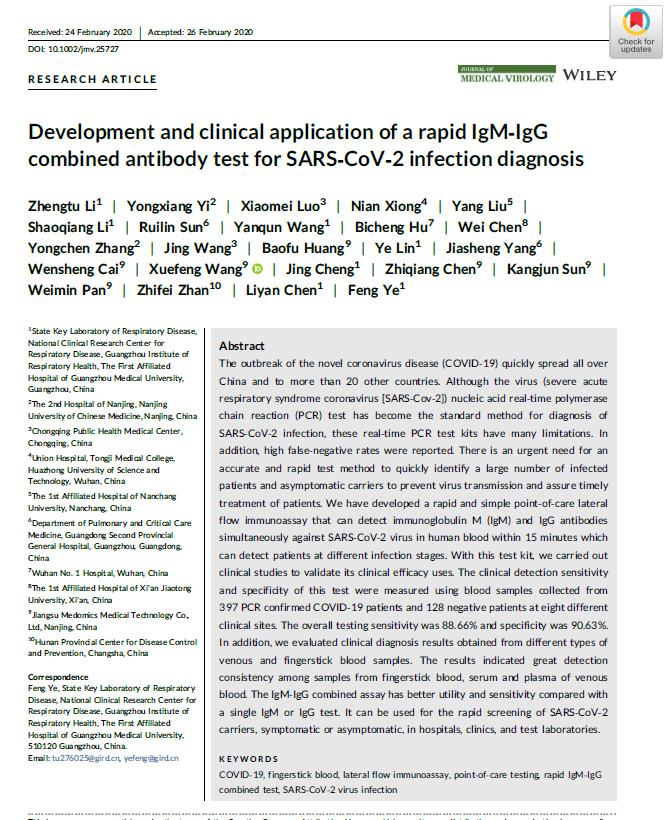
摘要:The outbreak of the novel coronavirus disease (COVID-19) quickly spread all over China and to more than 20 other countries. Although the virus (SARS-Cov-2) nucleic acid RT-PCR test has become the standard method for diagnosis of SARS-CoV-2 infection, these real-time PCR test kits have many limitations. In addition, high false negative rates were reported. There is an urgent need for an accurate and rapid test method to quickly identify large number of infected patients and asymptomatic carriers to prevent virus transmission and assure timely treatment of patients. We have developed a rapid and simple point-of-care lateral flow immunoassay which can detect IgM and IgG antibodies simultaneously against SARS-CoV-2 virus in human blood within 15 minutes which can detect patients at different infection stages. With this test kit, we carried out clinical studies to validate its clinical efficacy uses. The clinical detection sensitivity and specificity of this test were measured using blood samples collected from 397 PCR confirmed COVID-19 patients and 128 negative patients at 8 different clinical sites. The overall testing sensitivity was 88.66% and specificity was 90.63%. In addition, we evaluated clinical diagnosis results obtained from different types of venous and fingerstick blood samples. The results indicated great detection consistency among samples from fingerstick blood, serum and plasma of venous blood. The IgM-IgG combined assay has better utility and sensitivity compared with a single IgM or IgG test. It can be used for the rapid screening of SARS-CoV-2 carriers, symptomatic or asymptomatic, in hospitals, clinics, and test laboratories. This article is protected by copyright. All rights reserved.
关键词:COVID-19; Lateral flow immunoassay; Point-of-Care Testing; SARS-CoV-2 Virus Infection; fingerstick blood; rapid IgM-IgG Combined test
作者:Zhengtu Li; Yongxiang Yi; Xiaomei Luo; Nian Xiong; Yang Liu; Shaoqiang Li; Ruilin Sun; Yanqun Wang; Bicheng Hu; Wei Chen; Yongchen Zhang; Jing Wang; Baofu Huang; Ye Lin; Jiasheng Yang; Wensheng Cai; Xuefeng Wang; Jing Cheng; Zhiqiang Chen; Kangjun Sun; Weimin Pan; Zhifei Zhan; Liyan Chen; Feng Ye
单位:
(1)State Key Laboratory of Respiratory Disease, National Clinical Research Center for Respiratory Disease, Guangzhou Institute of Respiratory Health, the First Affiliated Hospital of Guangzhou Medical University, Guangzhou, 510120, China.
(2)Department of Pulmonary and Critical Care Medicine, Guangdong Second Provincial General Hospital, Guangzhou Guangdong, 510317, China.
(3)The 2nd Hospital of Nanjing, Nanjing University of Chinese Medicine, Nanjing, 210003, China.
(4)Chongqing Public Health Medical Center, Chongqing, 400036, China.
(5)Union Hospital, Tongji Medical College, Huazhong University of Science and Technology; Wuhan Red Cross Hospital, Wuhan, 430015, China.
(6)The 1st Affiliated Hospital of Nanchang University, Nanchang, 330006, China.
(7)Wuhan No. 1 Hospital, Wuhan, 430022, China.
(8)The 1st Affiliated Hospital of Xi'an Jiaotong University, Xi'an, 710061, China.
(9)Jiangsu Medomics Medical Technology Co., Ltd, Nanjing, 210061, China.
(10)Hunan Provincial Center For Disease Control and Prevention, Changsha, 410000, China.
期刊:Journal of Medical Virology
发表日期:2020 Feb 27
原文链接:https://doi.org/10.1002/jmv.25727